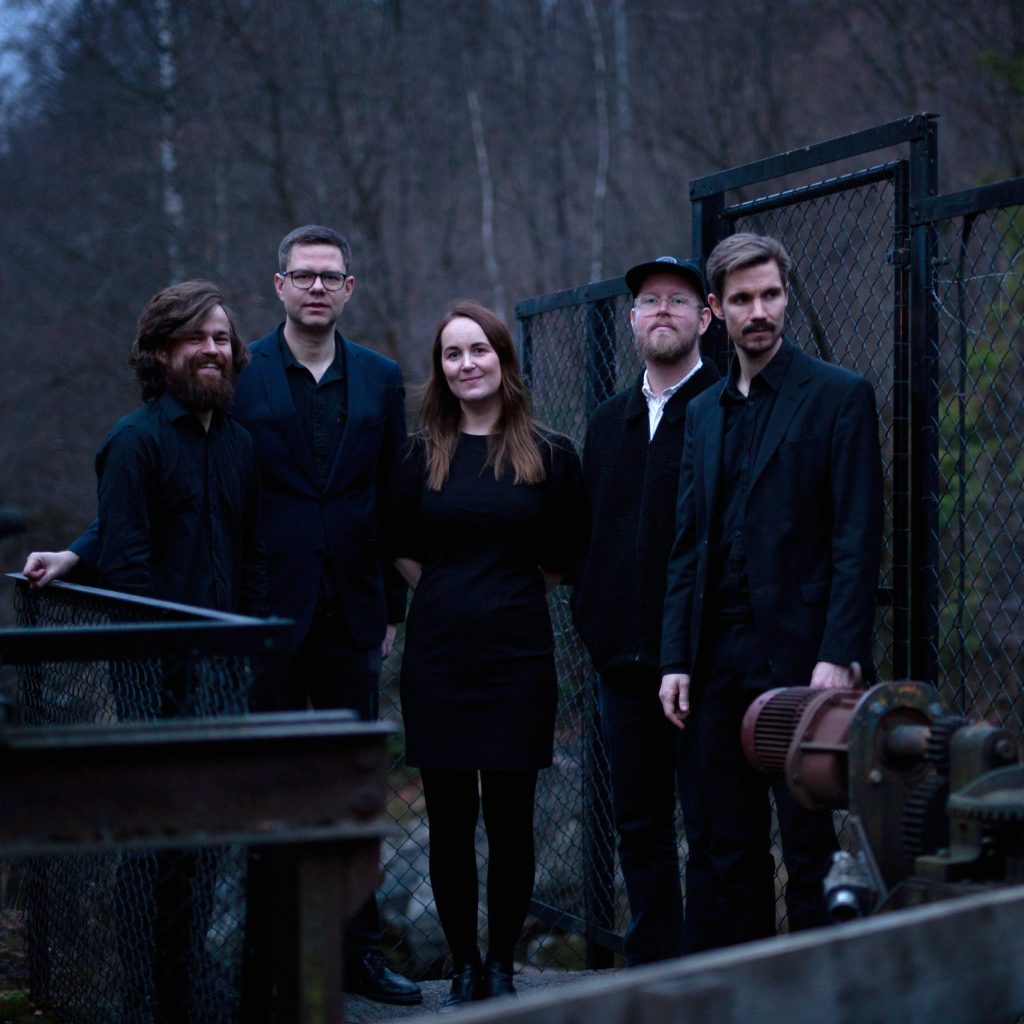
Ingi Bjarni Quintet
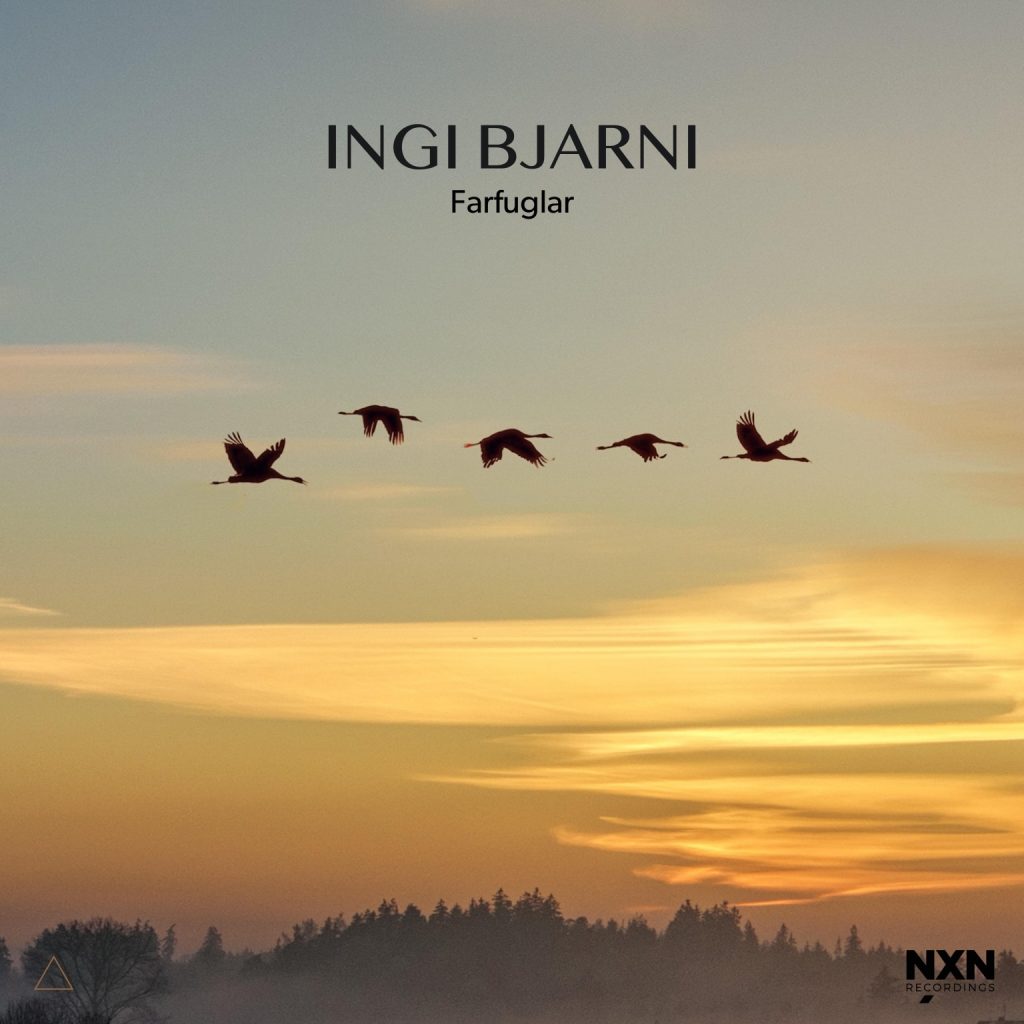
A Nordic five-piece of friends and collaborators – the albums Farfuglar and Tenging
About
Formed in 2018, the Ingi Bjarni Quintet gathers Nordic friends around the pianist’s compositions. The quintet balances polished arrangements with a high level of improvisation and a strong sense of space. In 2019, the quintet released its first studio album, Tenging (Connection). The album received positive reviews internationally and earned five nominations for the Icelandic Music Awards in 2020. In February 2023, the quintet released a new album called Farfuglar, which means “traveling birds” in English. The album was nominated as Jazz Album of the Year at the Icelandic Music Awards 2024. The quintet has toured Japan, Germany twice, Iceland, and the Netherlands.
For more information about the albums, please read the liner notes below.
Lineup
- Ingi Bjarni Skúlason — piano
- Jakob Eri Myhre — trumpet
- Merje Kägu — guitar
- TBA — double bass
- Tore Ljøkelsøy — drums
Releases / Listen

More links
- 📺 More videos here
- 📷 More photos of the quintet
- 🇩🇪 Reviews in German (for all my albums)
Liner notes from Farfuglar (2023)
It’s a thrill to observe the ongoing, shared prowess of these five creative soulmates, with the leader again writing especially for the clear intonation and textural interaction of trumpeter Jakob Eri Myhre, guitarist Merje Kägu, double bassist Daniel Andersson and drummer Tore Ljøkelsøy.
As a jazz musician, Ingi Bjarni Skúlason is both acclimatised to and fascinated by the travelling life (even when, out of necessity, they are ‘virtual’ collaborations across the miles). In the studio or concert hall, the quintet’s immersion and involvement in this creative environment – strongly defined by Ingi’s intuition and openness to the psychological flow – is affectionately described by the pianist as “destroying my music beautifully”! Quick to elucidate, he enthuses that their considerable skills lie in the exploration and interpretation of his received thoughts: “They always take them to another place, so the special ingredient is our development of the compositions, together. This instrumental blend is very satisfying, but so too is the dynamic and the relationship between us – not just in musical terms”.
This remarkable rapport can instantly be heard in the impetuous downward C to Eb motif of sparky opening number Þýðing (Translation), encouraging melodic hooks and spatial improvisations to be freely shared and intertwined – note, too, the tingling key-change elevation towards its close. By way of contrast, initially pensive Bjögun á dögun (Distortion of daybreak), subliminally inspired by folk tunes and Turkish music, builds its trumpet-led crescendo through rippling, finespun guitar effects; yet a second section reveals so many other facets, closing with the piano’s graceful slow waltz.
Meditative Það sem er (That is) explores the idea of surrendering to the moment, its plaintive, tonally attuned trumpet, guitar and piano lines weaving across the rhythm section’s shifting 3/4 and 4/4 metre before giving way to contemplative, aqueous keyboard explorations. Delicately lapping Knowing without knowing shares something of that final repose, though this melancholic ‘vocalese trumpet’ lullaby ultimately rises to Skúlason’s spiky chromaticism.
Such is the quintet’s adaptability that their drive-time earworm When holiday really begins (specifically, 26 December) invokes the late ‘70s pop of, say, Elton John and ABBA, yet is hallmarked by vibrant, instinctive jazz. The imagery of exquisitely awakening Farfuglar focuses on the wide skies of migration, the players’ smooth journeying disrupted by turbulent, angular intervals, while purposeful trumpet feature Að fljúga (To fly) suggests echoes as diverse as Edvard Grieg and prog rockers Genesis. To close, thematic Loftin blá (The blue sky) is characterised by extemporisations in breezy Scandinavian jazz before emotive piano elegy Mamma engill (Mother angel) gazes heavenwards in gratitude.
Attempting to convey the elusive spirit of delight – that higher plane – which can be summoned in this music, Skúlason describes it as “a state of mind where I almost don’t need to think; a feeling of ecstasy, that everything is right at this moment in time”. In Farfuglar, his quintet’s collective impressions of flight and abandon positively connect us with a panoply of atmospheres from which to soar in our imaginations.
Adrian Pallant, June 2022
Liner notes from Tenging (2019)
New quintet release Tenging (the translation of ‘connection’ in his Icelandic mother tongue) references Skúlason’s personal discovery of his inner musicality through the exploration of flow, freedom, confidence and, most pertinently, intuition. It brings together artists and friends from his longtime association with Scandinavia – Norwegian trumpeter Jakob Eri Myhre, Estonian guitarist Merje Kägu, Swedish double bassist Daniel Andersson and Norwegian drummer Tore Ljøkelsøy – in a fascinating encounter which expands the textural palette of his previous, well-received piano trio albums, Skarkali (2015) and Fundur (2018).
“I lived in Gothenburg, Copenhagen and Oslo while studying for my Masters degree in composition”, explains Ingi Bjarni, “and there, I met and performed with these amazing players. So the start of this project was chiefly about them as people and musicians, rather than a preconceived instrumentation, and I wrote all eight pieces on this album with their personalities and expertise in mind.” Skúlason’s choice of personnel is, indeed, inspired. Leading from the piano – equally as director, colorist and soloist – he observes the tonal synergy between Myhre’s trumpet lines and Kägu’s electric-guitar hues, enlivened by or ambiently bathed in the sensitive bass and percussion of Andersson and Ljøkelsøy. All the while, the spacial and improvised diversity of their output vividly reflects Skúlason’s desire to diminish boundaries of genre, though his work is particularly influenced by jazz tradition, Nordic folksong and electronica.
Listen to the smouldering jazz energy of Ballad for my fearless friend, for example, where memorable motifs are sustained by shimmering drum rhythms, or the elegance of the shared guitar and trumpet melodies in Kannski blús (Maybe a blues) prompting sparky improvisations, and the breadth of this quintet becomes apparent. From its sinewy opening, the folksy waltz of Já í dag (Yes today) brims with brightly fluctuating ideas, while the players revel in the freedom of bustling, bass-resonant Falin laglína (Hidden melody) and cantabile Angurvært (Bittersweet melancholy). Ingi Bjarni’s pianistic solo delicacy is encountered in wistful, chromatic Á sunnudegi (On a Sunday) and a tender, Bill Evans-like miniature, Ekki þjóðlag, ekki jazz (Not a folk song, not jazz); and the title track’s varietal strands beautifully encapsulate the connective belief amongst this quintet.
“I’m excited to release Tenging”, enthuses Skúlason, “as it’s about continuing to find my artistic path and identity, and I feel it’s my best contribution yet. Already knowing and respecting these players has meant that I can approach this project as composer and arranger while also enjoying greater flexibility in my own playing – a change from my trio environment, which is naturally conceived more around the piano.” Neatly summing up the importance of intuition and connection above intellectualism in his art, he considers: “I wonder if we truly know ourselves, and what we can be capable of in life and music. To me, ‘music’ is already here. It’s an ever-flowing waterfall – and our creativity depends on how much we lean ourselves into it.”
Adrian Pallant, 2019
Farfuglar — nominated Jazz Album of the Year (2024). Tenging — five IMA nominations (2020)
Press
“a suite of genre-bridging music of captivating poetic ambience, rooted in an overall subtlety of melodic figure and rhythmic interaction….A distinctive and rewarding album, which impresses more and more with each hearing.”
Jazz Journal (UK)
“Tenging is a highly accomplished work of art that flows with ease and coherence….Ingi Bjarni is deserving of wide recognition for his skills as a composer as well as his perceptive piano playing.” ”
All About Jazz (USA)
“A wonderful album that captures the North as it sounds when mixed with the various musical influences of this world. ”
Concerto Magazin (AT)
“In short, Ingi Bjarni is profiling himself as an improvising sound magician.”
Musiczine (BE)
Selected Touring
Transilvania Jazz Festival 2025 · Japan tour 2024 · Germany tours 2024 & 2021 · Jazz Maastricht 2023 · Iceland tour 2019